Personal, 2024
From the fireside to FaceTime: the search for an online Third Space
It is rare, I think, to find something that perfectly encapsulates the mood of an era. Amongst the many attempts by artists, novelists, musicians and philosophers there are few that have succeeded; The Great Gatsby’s representation of the hard-partying yet melancholic timbre of the 1920s; the encroachment of industrial modernisation in the 19th century captured in the fleeting strokes of the Impressionist movement; anxieties about national security and identity broadcast in the superhero blockbuster boom of the noughties.
These cultural objects are the result of intricate craft, years of toil, a clearsighted objective to be the voice of a cultural moment and, often, billions of dollars. But sometimes you come across something that does so totally accidentally, and completely unselfconsciously. Recently, while scrolling on the app Nextdoor, I found just that.
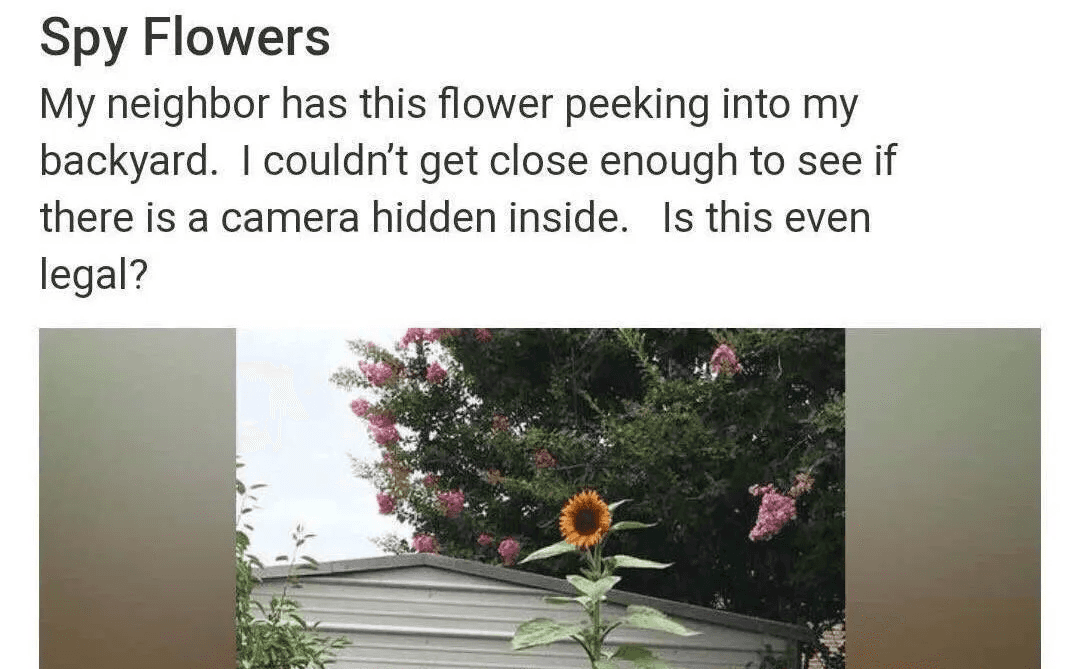
If you’re not familiar, Nextdoor is a community app for neighbourhoods, whose core mission is ‘to cultivate a kinder world where everyone has a neighbourhood they can rely on’. It’s an online space designed to develop and facilitate the type of neighborliness seen in 1950s advertisements- their Manifesto irresistibly conjuring images of white picket fences, pot-roasts, dental-neat rows of detatched houses and Truman show smiles;
“We are for neighbours. For neighborhood barbecues. For multi-family garage sales. For trick-or-treating. We’re for slowing down, children at play. We’re for sharing a common hedge and an awesome babysitter”
For all it’s tooth-aching, even stomach-turning earnestness, this is still surely the kind of environment anyone would want to live in. In fact its sorely needed, with article after article proclaiming the proliferating isolation epidemic, the degradation of the family unit, the polarisation of our politics. But, despite its good intentions and lofty ambitions, Nextdoor is not the solution. In fact it seems to be have become an enabler of some of society’s most injurious social habits and afflictions.
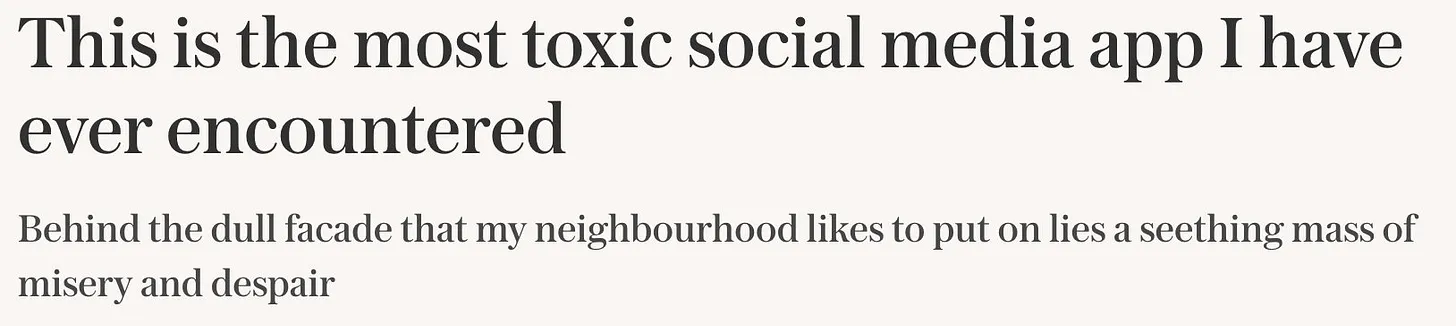
Just like any other online platform Nextdoor is inescapably plagued by the viciousness we see everywhere on social media. There is even a Reddit thread dedicated to the most dramatic Nextdoor interactions, with the tagline ‘join us for the dumpster fire’. It is in the top 3% of Reddit communities by size.
Harassment, cancel culture, misinformation, outrage-bait and prejudice are not things that are new to an online environment. But the experience of online abuse on Nextdoor is different: the trolls are not anonymous, they live on your road.
To belong to a neighborhood on Nextdoor you have to verify your address. Many theories about the toxicity of the Internet suggest that a key driver is the anonymity of the online world, but it turns out that even when we’re identified by our very postcode we still cannot be kind, respectful, or even decent to one another.
Nextdoor is just one app, and there are many others out there with far worse levels of vitriol. But it is this disconnect between online abuse and real life neighbourhood that fascinates. Because Nextdoor, I think, is symptomatic of what I think its a central issue for our era- a complete lack of community.
This is what I saw in that first image, and why I think its one of those rare artefacts that takes the temperature of a culture, or time period. Its the assumption of threat in the face of something so pure, the hyper-individualistic territorialism, the missed, or even rejected, opportunity for connection.
Back in 2023, the World Health Organisation declared loneliness a ‘global public health concern, and launched an international commission on the problem. The UK actually created, back in 2018, a minister for loneliness, and Japan and Australia followed suit. It’s a problem that was of course exacerbated by the coronavirus pandemic, and which affects young people in particular. According to the Campaign to End Loneliness, in 2019, 23% reported feeling lonely some of the time, in 2022 it rose to 50%, and in 2024 the figure is 58%. This suggests that while the pandemic is the genesis of a wave of loneliness, it has only proliferated since then.
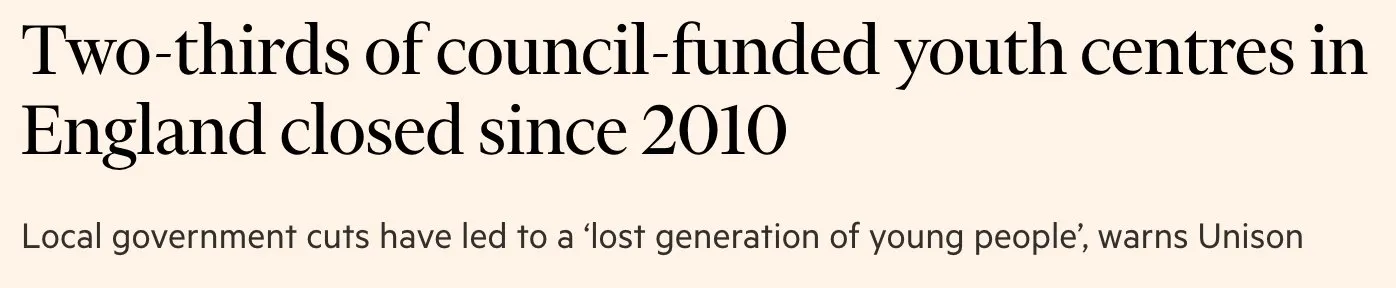
One of the drivers of this, I would suggest, is the collapse of third spaces. A third space, before it became a luxury gym, is a social environment that is separate from work and home. Third spaces have been highlighted as important elements of civil society, democracy and civic engagement, and vital in the formation of a sense of place and identity. But many of these places where people could gather, like music venues, sports halls, libraries and youth centres are disappearing, as simultaneously our screen time skyrockets.
Residing within all of us is the dumb primal need to sit around a fire in a cave together- to feel part of something larger. It is a thread that you can pull through the annals of history, across every era and every culture; the symposiums of Ancient Greece, the village feasts of the Medieval times, the balls and salons of the Victorian and Regency eras. We must gather, we must tell stories, we must laugh and cry in the company of others. We reach out, again and again, to be together. It’s inherent in us- a basic human need. And when we can’t meet that need, things can get quite ugly.
It’s no surprise that we’ve been desperately trying to cobble together a digital replacement for community. But what we’ve achieved is a pale imitation, one that at its best, fails to stimulate glowing feeling of togetherness and, at its worst, eviscerates it entirely. Nextdoor is one salient example, but we see similar digital substitutes for community blossoming incessantly across TikTok.
On TikTok instead of concrete communities which might have provided identity, belonging, connection, young people, especially young women, are offered a kind of landscape of ‘aesthetics’ that is continually shifting underfoot.
Cottagecore is a now infamous example, but in its wake we also see aesthetics such as ‘tomato girl’, ‘clean girl’, ‘mob wife’, becoming more and more niche until you get to ‘goblin girls’, ‘onion girls’. These are all based around a collection of visual references, (a tomato girl for example, likes the colour red and flowy patterned clothing, while a clean girl sticks to white, and lipgloss). 2025’s most viral example if the pink Pilates princess- a Pilates obsessive who has a beautifully curated collection of pink workout attire and single minded focus on wellness.
These communities have no gathering place, no common behaviors, no substance and an arbitrary taxonomy that cannot be kept up with. They are extinguished almost as quickly as they have begun. Crucially, in order to belong to them you must engage in an almost feverish feat of consumerism- the qualifying criteria is merely an Amazon order of the right combination of things.

Maybe there’s little harm in buying a red lipstick because you want to feel like a summery ‘tomato girl’, and if you get a shot of that warm buzz of belonging then that’s a happy benefit. But as the algorithmic cycle churns, these aesthetics are morphing and evolving into something much more sinister. Beneath their harmless sheen, many aesthetic groups- cottagecore, clean girl, pilates princess, soft girl- promote a very specific lifestyle for women and girls, one where they reject work, focus on their appearance, have perfect children and stay home (save for their workouts)- in other words one entrenched in traditional gender roles. Recently we’ve seen this crystallise into a very specific community; the TradWife. The TradWife aesthetic signals a step-change- no longer are the conservative traits oblique, they are up front and personal, with ostensibly blissed out women extolling the benefits of rejecting work and dropping out of education to marry.

Housewifery is of course an important and fulfilling role for many. But these communities showcase an idealized and surgically perfect vision of that role, with little room for nuance, nor for the many and diverse choices available to women. The price of entry, therefore, is much steeper than an Amazon purchase.
There’s a quote that I love but which I cannot attribute to a source- everyone wants a village, but nobody wants to be a villager. This, I think, is a crucial reason for the failure of these online communities to meet our needs. Online, it is easy to feel that we don’t owe one another anything, but being in a community is a commitment to both the benefits and the ugliness of being together. You cannot have a village without a willingness to both offer and receive support, without vulnerability, respect and even sometimes disgust. Behind the screen, even those sharing a wall or babysitter with us seem divorced from our reality, seem undeserving of respect or even separate to the concept. Community is work, and from that work comes meaning and beauty and online that work is smoothed away, and so too is everything else.
Luckily, there are people out there who are willing to do the work, and this seems to be the case more and more so.
If you have ever been to a London park on the weekend, or any coffee shop in their vicinity you might have seen a group of lycra clad people striding the pavements. Running, a once totally solo endeavour has been transformed into the new social event, and in turn is helping people build communities in cities and centuries that feel alienating.
Meanwhile, book clubs are similarly experiencing a renaissance. Book club listings on Eventbrite increased by 350% between 2019 and 2023. You can go to Sheffield Feminist Book Club, Modern Chinese Literature Book Club, Crime and Nourishment Book Club. Supper clubs are undergoing the same transformation- there are now hoardes of apps that team up groups of strangers to go for dinner together.
While we struggle on a government level to support third spaces, these groups are plugging the gaps, and brands are also reaping the commercial rewards- Puresport, the CBD wellness brand can attribute some of its success in beating its £1.3, crowdfunding goal to its run clubs that dominate the London scene. Last summer Tinder teamed up with Runna to launch a free run club series called Solemates.
I used to live nearby to Hampstead Heath Ladies Pond. If you’ve never been, the Hampstead Heath ponds are quite literally just a pond, with no formal changing rooms, unheated outdoor showers, and lots of mud and weeds. The water is murky and greenish and the temperature is baltic. On a hot sunny weekend, I’d go with friends, shrieking in the freezing water and lying out in the meadow afterwards chatting with our faces like sunflowers, turned towards the sun. But I also often went alone, well into October and November on the miserable weeknights or on a dreary Saturday afternoon when plans had fallen through. There were quite a few regulars who did the same. I never knew the names of these women, and rarely said more than a few words to them but they were a community that I cherished. Maybe it was the trust we put in one another as we braved the icy water, maybe it was the fact that women have been swimming in these ponds since 1926. But as I nodded to the swim-capped heads as a I swam by I always had a distinct feeling of being seen, of being held, of being together.
It’s easy to go on a diatribe about the loneliness epidemic, the far-right groups proliferating on TikTok, the damaging nature of social media. But what can we do about it- it’s the big churn and we’re just part of it. Well, I don’t think so. Community does not have to be a big performative thing, it can be as simple as nod as you swim past to say ‘I’m as mad as you are’.
Take a look at what else I've written!